
How to Write a Strong Academic Introduction: Structure, Purpose, & Common Questions
Many students, early researchers, and even some experienced writers misunderstand one of the most important parts of academic writing: the introduction. Some treat it as a decorative opening. Some try to place everything they know into it. Some confuse it with the literature review, while others reduce it to two or three vague paragraphs that reveal very little. As a result, a paper may contain an intriguing topic, relevant references, and even useful findings, yet still appear weak from the very beginning because the introduction fails to perform its proper function.
Before proceeding, we must acknowledge one crucial point: although academic writing demands clarity and structure, this does not mean that every writer must force their work into one rigid pattern. Each writer has a unique way of arranging ideas, building emphasis, and creating movement within a text. Such individuality should not be dismissed. The goal of strong writing is not blind obedience to a single model, but the creation of a logical and readable flow through which the reader can grasp the purpose and direction of the text without unnecessary struggle. The real question, therefore, is how ideas are arranged to make sense at first glance and unfold with coherence, rather than what must or must not appear in an introduction. Structure should support understanding, not suffocate style.
What is an Introduction?
An introduction is not merely the first section of a paper. It is the entry point into the logic of the whole work. It tells the reader where they are, why they are there, what issue deserves attention, and what the article is going to do. In a strong academic paper, the introduction does not simply begin the discussion; it orients the reader intellectually. That is why a weak introduction creates confusion even before the reader reaches the main analysis, whereas a strong one makes the rest of the article easier to understand, easier to trust, and more convincing overall.
An everyday human example can help us understand the introduction in many ways. When a person is introduced properly, whether by someone else or by themselves, the introduction usually follows a natural and logical flow. It does not begin in the middle, jump to unrelated details, or create confusion about who the person is and why they matter in that context. Writing works in much the same way. Whether one is writing an article, thesis, dissertation, book, or reflective essay, the opening should guide the reader with clarity and sequence. A poorly arranged beginning weakens the effect of everything that follows, while a smooth and thoughtful introduction prepares the reader for deeper engagement.
One of the most common mistakes in academic writing is the belief that the introduction is the place to present all important material at once. Yet academic writing depends not only on content but also on function. Each section is defined by what it is supposed to do, and the introduction has a specific role. Once it begins doing the work of several later sections, it loses clarity.
In the simplest terms, an introduction explains what the paper is about, why the topic matters, what problem or gap exists, and what the paper will do. That is its core role. A good introduction guides the reader from a broad area of interest toward the exact focus of the paper. It does not throw the reader into details too early. Instead, it creates an intellectual path: it introduces the topic, narrows the focus, identifies the issue or gap, states the purpose of the article, and often ends with the research questions, objectives, or a brief statement of structure. This movement from broad to specific is what gives the introduction its shape. Without that movement, a section may contain useful information and still fail as an effective introduction.
The first task: introducing the topic
Every introduction begins by bringing the reader into the field or topic area. This opening does not need to be dramatic, but it does need to be meaningful. The reader should quickly understand what the paper is concerned with. If the paper is about language, the opening should make that clear. If it is about education, policy, media, culture, or literature, that should become visible at once.
This part of the introduction should not be too broad. Many weak papers begin with sentences so general that they could fit almost any topic in the world. Statements like “Language is very important in human life” or “Education plays a vital role in society” are not wrong, but they are often too empty to help the reader. A strong introduction begins broadly enough to provide context but narrowly enough to stay relevant. In other words, the opening should not merely say something true. It should say something useful.
The second task: narrowing the focus
After introducing the general topic, the writer must narrow the discussion toward the exact subject of the article. This is where the introduction begins to gain direction. A broad topic is not yet a research problem. The writer must move from the larger field into the specific issue the paper will address.
This narrowing is essential because academic writing is not about discussing a whole universe. It is about isolating one meaningful problem within that universe. A strong introduction therefore helps the reader move from “this is the broader field” to “this is the exact matter this article is concerned with.”
When this narrowing does not happen, the introduction remains vague. The reader may understand the theme of the paper, but not its real focus. That is one of the key reasons many articles feel blurry even when the topic itself is captivating.
The third task: showing why the topic matters
A successful introduction does not assume that the importance of the topic is already obvious. It explains why the issue deserves attention. This does not mean the writer must exaggerate or pretend that every topic is revolutionary. It simply means the paper should justify its relevance.
Relevance can be shown in different ways. A topic may matter because it has been understudied. It may matter because it is misunderstood. It may matter because it affects interpretation, social understanding, education, culture, language use, public discourse, or theory. The introduction should make that relevance visible in a direct and logical way.
This moment is the point where the reader begins to feel that the article has a reason to exist. Without this sense of significance, the article may appear technically competent but intellectually unnecessary.
The fourth task: identifying the problem or research gap
This step is one of the most important parts of the introduction. A paper does not become scholarly simply because it has a topic. It becomes scholarly when it identifies a problem, a gap, a tension, or an unresolved issue.
The research gap is not just a ritual sentence such as “very few studies have been done.” A real gap is more precise. It may be that previous work has examined the topic from one angle but ignored another. It may be that the topic has been discussed in general terms, but not in a particular language, region, genre, period, or framework. It may be that scholars disagree or that one element of the phenomenon has not been sufficiently explained.
A strong introduction makes this gap clear. The reader should be able to say, "Now I understand what is missing and why this paper is needed.” That moment is crucial. Without it, the article may look like one more piece of writing on a known subject rather than a focused scholarly contribution.
The fifth task: stating what the paper will do
Once the topic, significance, and gap are clear, the introduction must tell the reader what the article itself sets out to do. This is where the writer states the aim, purpose, or central argument of the paper. This part should be direct. It is not the place for excessive mystery.
Academic readers do not want to guess what the paper is doing; they want the paper to tell them. A strong introduction therefore contains a sentence or short passage that clearly states the paper’s aim.
This is also the place where many papers become much stronger or much weaker. If the aim is vague, the paper feels directionless. If the aim is too grand, the paper sounds unrealistic. If the aim is well-phrased and appropriately sized, the paper immediately gains authority.
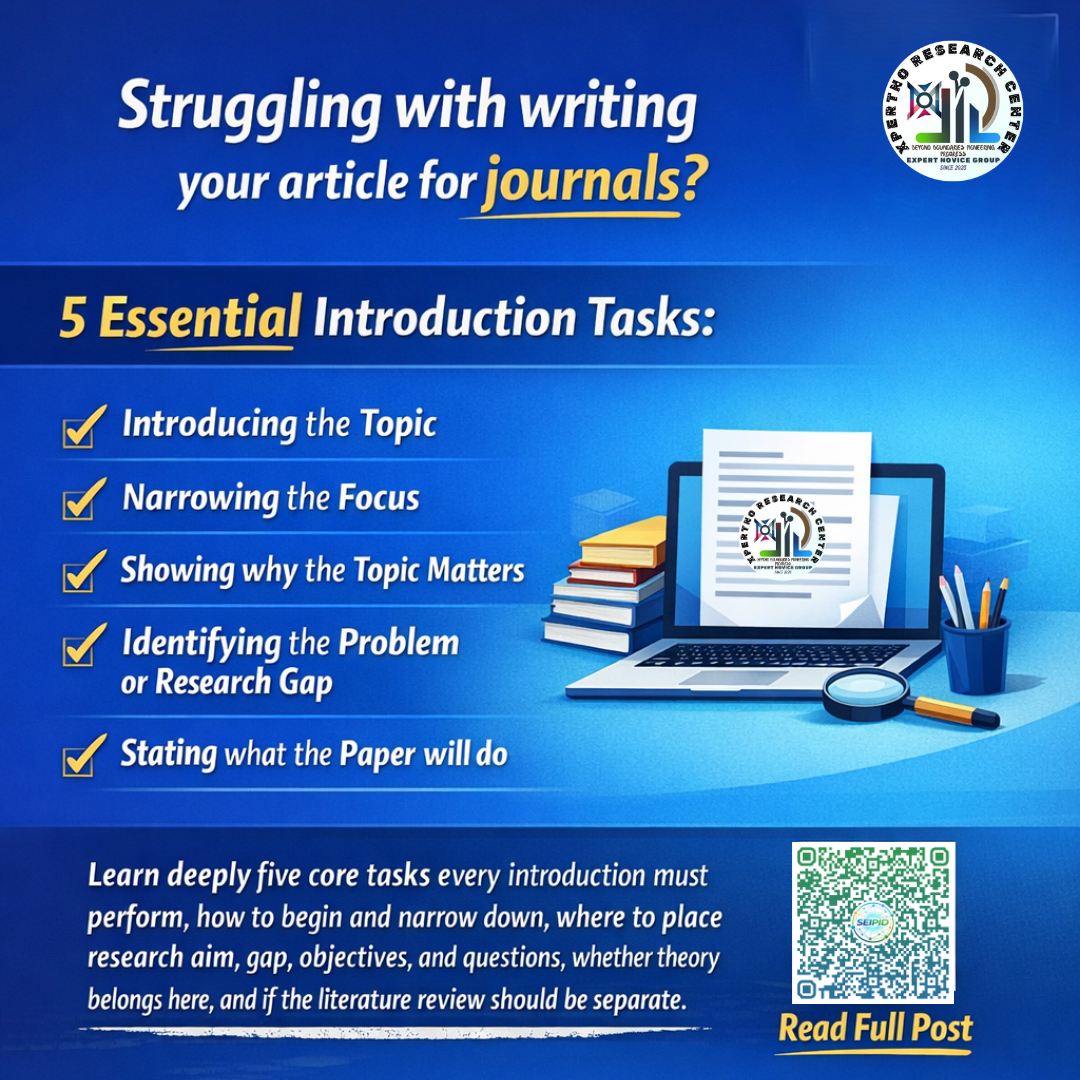
These are some of the core tasks that a strong introduction usually performs, whether they appear in continuous paragraphs, under clear subsections, or through another well-arranged structure. This doesn't mean every paper must follow one strict pattern or that these are the only possible intro elements. What matters most is logical flow, coherence, and clarity of purpose. At every stage of writing, claims should be supported rather than casually assumed, definitions should not be imposed without care, and conclusions should not be hinted at as though they were already proven. The language of the introduction should remain concise, controlled, and intellectually honest so that the reader is guided by what the paper genuinely establishes rather than by presupposed meanings or premature results.
Should Research Objectives or Research Questions Be in the Introduction?
In many academic articles, especially in the humanities and social sciences, research objectives or research questions appear near the end of the introduction. This is often the most effective place for them because, by that stage, the reader has already been guided through the topic, its significance, the existing gap or problem, and the overall purpose of the paper. When placed there, objectives and questions do not feel abrupt. Instead, they emerge naturally from the discussion that has already been built, and they prepare the reader for what the article will specifically examine from that point onward.
When research objectives or questions appear too late, their force is reduced. They may begin to look inserted rather than organically developed. The reader may already have moved through several pages without clearly knowing what the article is trying to answer or achieve. By contrast, when they are presented at the end of the introduction, they serve as a bridge between the opening logic of the paper and the detailed discussion that follows. They tell the reader, with clarity and direction, exactly what the study intends to pursue.
At the same time, it is important to understand what research objectives and research questions actually are, because they are closely related but not identical. Research objectives are the specific aims of the study. They state what the paper seeks to do, examine, analyze, compare, explain, or demonstrate. In simple terms, objectives express the intended scholarly task of the article. Research questions are the focused queries that the study seeks to answer through its argument, analysis, or investigation. Objectives usually express purpose, whereas questions express inquiry. One tells the reader what the study sets out to accomplish; the other tells the reader what the study is trying to find out or clarify.
Because of this distinction, both objectives and questions should be specific, clear, and directly connected to the actual scope of the paper. They shouldn't be too broad, as this promises more than the article can deliver. A weak objective is often vague, oversized, or inflated. A weak research question may sound impressive, but if it is too general, too philosophical, too obvious, or too disconnected from the actual material of the study, it does not help the paper. Strong objectives and questions are focused enough to be answerable, relevant enough to matter, and narrow enough to match the evidence and method of the article.
Writers should therefore avoid research questions that are overly broad, ambiguous, or shaped in a way that already assumes the answer. A question should not be so wide that it could produce an entire book instead of one article. Nor should it be so obvious that it answers itself. In the same way, objectives should not be written in inflated language that makes the study sound grander than it is. Phrases that suggest total explanation, final proof, or sweeping coverage should be used with extreme care. Academic writing becomes stronger when objectives and questions are disciplined, proportionate, and honestly aligned with what the paper can actually do.
It is equally important that objectives and questions reflect the logic of the paper rather than appearing as a formality. They should grow out of the introduction itself. If the introduction has properly established the topic, significance, and gap, then the objectives or questions should feel like a natural next step. They should not look mechanically inserted just because academic writing is “supposed” to include them. Their value lies not in their mere presence, but in how effectively they guide the structure and focus of the article.
Not every article must present explicitly listed research objectives or research questions. Some papers, especially certain theoretical, reflective, or interpretive works, may state their purpose without formally separating it into numbered objectives or questions. However, the end of the introduction is typically the most natural and effective place to use objectives or questions. There, they provide direction without interrupting the flow, and they help ensure that the paper moves forward with clarity, coherence, and purpose.
Can Theory Appear in the Introduction?
Yes, theory can certainly appear in the introduction, and this is one of the points that often creates confusion among writers. There is nothing inherently wrong with mentioning the theoretical lens through which a study will be approached. Often, doing so is not only acceptable but useful, because it helps the reader understand the intellectual direction of the paper from the very beginning. If a study is being approached through discourse analysis, narratology, stylistics, pragmatics, semiotics, or another framework, the introduction may briefly identify that perspective and indicate why it is relevant to the topic.
The difficulty does not lie in the presence of theory itself, but in the extent and proportion of its use. A brief and focused reference to theory can strengthen the introduction by clarifying the paper’s orientation. However, when the introduction turns into a long theoretical exposition, it begins to perform the work of a later section rather than its own. At that point, the structure of the paper becomes unbalanced. The introduction is meant to orient the reader, not overwhelm them with an extended theoretical debate before the central purpose of the article has properly unfolded. Theory, therefore, may appear in the introduction, but it should remain in service of the introduction’s role rather than competing with it.
In the case of journal articles, I would generally suggest that if a theory is being used, it is often sufficient to explain it briefly within one paragraph, or at most two if necessary, in the introduction itself. This principle is especially true because an article is usually designed to communicate a focused argument, a specific inquiry, or a limited piece of research in a concise and disciplined form. An article usually avoids sustaining long and heavily extended discussions of every supporting element, unlike a thesis or dissertation, unless the nature of the study genuinely requires it. For that reason, in many articles, a compact mention of the theoretical lens in the introduction is often more effective than creating a long and separate section that delays the movement of the paper.
This does not mean that a separate theoretical section is always wrong. If the argument, method, or complexity of the study genuinely demands a fuller explanation, then such a section may certainly be included. The real issue is not whether theory must appear in the introduction or in a separate section, but whether it is presented in a proportionate and useful way. In strong academic writing, the treatment of theory should match the size, purpose, and demands of the article itself.
Does an introduction need subsections?
Not necessarily. Many journal articles simply have one heading: Introduction. Inside that section, the writer still moves through background, narrowing, gap, aim, and questions, but without separate subheadings. This is very common and often preferred in shorter or more traditional articles.
In some longer or more technical articles, the introduction may contain mini-subsections such as background, problem statement, or aims. That is also acceptable if the journal style allows it. The real issue is not whether there are internal labels. The real issue is whether the introduction moves logically and performs its proper role.
Therefore, an introduction may be written with subsections or without subsections. Both can work. Structure is not only about headings; it is about intellectual order.
Should the Literature Review Be Part of the Introduction or a Separate Section?
This is a crucial question, and the answer is not completely fixed. In academic writing, both approaches can be valid. A literature review may appear as part of the introduction, or it may be presented under a separate heading. The better choice depends on the type of article, the length of the paper, the discipline, the complexity of the topic, and the role previous scholarship plays in the argument. For that reason, the issue should not be decided rigidly. It should be decided logically.
In many journal articles, especially shorter ones, the literature review is not always separated under its own heading. Instead, relevant studies are woven into the introduction itself. The writer introduces the topic, provides some background, refers to important scholarship, narrows the discussion, identifies the gap, and then moves toward the aim of the study and the methodology. This approach is common and often very effective, particularly when the article is limited in length and the review of previous scholarship is meant to support the opening logic rather than stand as a large discussion on its own. In such cases, it is perfectly acceptable for literature to appear within the introduction, provided that it remains focused and contributes to the movement of the paper.
This is why the mere presence of reviewed studies inside the introduction is not a problem. In fact, in many articles, it is necessary. Before properly narrowing the topic, a reader often requires some scholarly background. If an article moves directly from a broad opening to methodology without briefly situating itself within existing work, the paper may feel underdeveloped or intellectually isolated. Referring to previous studies in the introduction can therefore help establish context, show awareness of the field, and prepare the ground for the gap or problem the paper is addressing.
However, the matter changes when the discussion of literature becomes too broad, too detailed, or too central to the argument. If the paper requires substantial engagement with earlier scholarship, competing viewpoints, theoretical debates, or multiple strands of prior research, then a separate literature review section often becomes the better choice. This is especially true when the review is not merely supporting the introduction but performing a larger scholarly task of synthesis, comparison, critique, or positioning. In such cases, keeping all of that material inside the introduction can make the opening too long, too dense, and structurally overburdened.
That is often the real dividing line. If the literature is being used to provide brief scholarly grounding and to help move the paper toward its gap and purpose, then integrating it into the introduction may be entirely suitable. But if the paper needs a deeper and more systematic account of what has already been written, then the literature review should usually stand as its section. The decision, therefore, should not be based on habit alone but on function. One must ask: is the literature here serving as background to the study, or is it itself a major stage of the study’s scholarly argument?
From a practical academic perspective, I would suggest that if the article is short or medium in length, if the number of prior studies being discussed is limited, if the discussion is closely tied to introducing the topic and establishing the gap, and if the review does not require extended comparison, then it is often better to integrate the relevant literature into the introduction. This keeps the article moving and prevents unnecessary fragmentation. In such cases, the writer may begin with the topic, bring in selected scholarship as background, narrow the issue, show the gap, and then proceed naturally toward the purpose, questions, and methodology.
On the other hand, if the article deals with a highly debated topic, a large body of previous research, multiple schools of thought, or a framework that must be carefully distinguished from earlier work, then a separate literature review section is often the more disciplined option. It provides the article breathing space. It allows the introduction to remain an introduction, while the literature review performs the task of deeper scholarly mapping. This is especially helpful when the writer needs not only to cite earlier work but also to compare it, critique it, group it, and show how the present study enters that conversation.
A balanced approach is often the best one. Even when there is a separate literature review section, the introduction may still contain a few key references to establish the field and lead into the problem. Likewise, even when there is no separate literature review heading, the integrated discussion of prior scholarship should remain selective and purposeful. The goal is not to follow a mechanical formula but to preserve clarity, proportion, and flow.
Careful consideration is necessary when choosing to include literature in the introduction. The writer should not simply pile up references. The reviewed studies should appear where they help the reader understand the topic, the direction of the field, and the reason the present study is needed. The literature should not interrupt the movement of the introduction; it should strengthen it. This means the writer should move from topic to relevant scholarship, from scholarship to narrowing, from narrowing to gap, and from gap to purpose. In that way, the literature becomes part of the article’s opening logic rather than a detached list of names and citations.
However, if the review exists as a separate section, the writer should still refrain from transforming it into a catalogue of summaries. A literature review is not merely a place to say who said what. It should identify patterns, tensions, limitations, and spaces for contribution. Whether it is integrated into the introduction or presented separately, a literature review should remain analytical, selective, and relevant to the study’s own direction.
Do not decide the placement of the literature review based on imitation alone. Do not assume that one model is always correct. Ask instead what the article needs. If brief and targeted references are enough to establish the field and gap, integrating literature into the introduction is entirely sound. If the paper depends heavily on sustained engagement with existing scholarship, then a separate literature review section is usually the wiser and more academically controlled choice. In both cases, what matters most is not the label, but whether the structure remains clear, logical, and proportionate to the purpose of the article.
What Makes an Introduction Strong?
A strong introduction feels controlled. It does not rush. It does not wander. It does not try to impress by overloading itself. Instead, it leads the reader with confidence. By the end of a strong introduction, the reader should know the answer to these questions:
- What is this paper about?
- Why is this topic worth discussing?
- What issue or gap does the paper address?
- What exactly will the paper do?
- What questions or direction will guide the paper?
If the reader can answer these questions clearly, then the introduction has done its job.
Final Thoughts
To understand an academic introduction properly, one must stop thinking of it as “the first few paragraphs” and start thinking of it as “the section that establishes the paper’s intellectual contract with the reader.” It states, "This is the area, this is the problem, this is why it matters, and this is what this article will do."
Once that is understood, many other structural decisions become easier. The writer no longer tries to put everything at the front. The literature review becomes more focused. The methodology becomes more distinct. The analysis becomes more grounded. The conclusion becomes more earned.
A successful paper does not begin by saying everything. It begins by saying the right things in the right order. That is what a real introduction does.