
SEIPID Reopens Registration with a Free Trial for Journals, Publishers & Repositories
Islamabad—In a digital scholarly landscape where discoverability often depends on unstable links, fragmented metadata, and expensive infrastructure, SEIPID has formally reopened registration, offering a renewed invitation to journals, repositories, archives, publishers, and academic institutions seeking a more structured and sustainable identification system.
The reopening is not being presented merely as a technical relaunch. Rather, it marks a broader shift in how SEIPID now defines itself: not simply as a code-assignment service, but as a developing layer of scholarly infrastructure designed to preserve record stability, metadata continuity, and institutional identity in a changing digital environment.
Developed under the governance of the Xpertno Research Center, SEIPID has spent recent months undergoing a significant rebrand and conceptual restructuring. The result is a clearer and more focused model—one that places emphasis not only on assigning persistent identifiers but also on ensuring that scholarly outputs remain traceable, interpretable, and formally anchored even when the web itself becomes unreliable.
At the center of the reopening is a new entry point for users. Newly registered accounts are now being welcomed through a three-month free trial, giving institutions and independent knowledge platforms an opportunity to explore the system before entering long-term subscription models. The current onboarding structure includes one namespace and 25 free SEIPIDs, providing early users with enough room to understand the mechanics of registration, resolution, and metadata handling within a real working environment.
Check out SEIPID's affordable plans!
For many smaller journals, institutional repositories, independent archives, and emerging publishers, such an opening may carry practical significance. Across much of the academic world, persistent identification remains associated with systems that can be financially restrictive, administratively rigid, or technically out of reach for newer and less-resourced entities. SEIPID appears to be positioning itself as a response to that imbalance—not by rejecting standards of seriousness, but by trying to make structured identification more accessible without stripping it of governance, clarity, or long-term value.
The platform’s language has also matured. What was once easy to read as a technical project is now being framed more openly as a scholarly ecosystem tool. This distinction matters. In research publishing, the value of an identifier does not lie in the string itself, but in the stability, metadata quality, and institutional trust that surround it. SEIPID’s reopening signals an attempt to compete at that deeper level: not only by assigning an identifier, but by creating a recognizable system in which the identifier carries structured meaning.
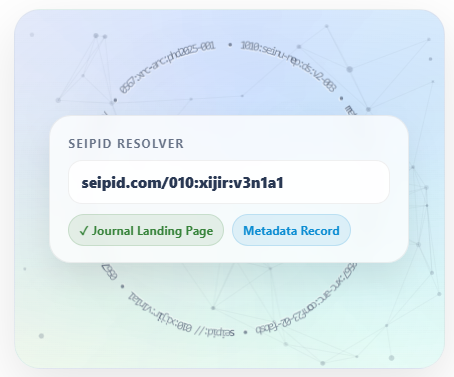
That structure is built into the anatomy of the SEIPID itself. Each identifier follows a model composed of prefix, namespace, and suffix, allowing records to be connected not just to individual outputs but to the broader environments in which they are produced and maintained. This helps support use across multiple scholarly categories, including journals, repositories, archives, and publishers, while laying the groundwork for more organized metadata governance as the system grows.
Yet perhaps the platform’s most distinctive argument lies in its resolver logic. In many digital publishing contexts, a scholarly item is only as visible as the webpage on which it lives. When a site changes, a domain expires, or a page disappears, discoverability collapses with it. SEIPID is attempting to answer that vulnerability through an approach that does not end with identifier assignment. If a publisher page becomes unavailable, the system is designed to preserve continuity through an official metadata landing page or fallback record. In simple terms, the record is not meant to vanish merely because its original web location fails.
See How the Resolution Model Works!
That promise touches a sensitive nerve within the scholarly communication world. Link decay, site migrations, underfunded repositories, and incomplete metadata systems continue to weaken access to academic material across many regions. The reopening of SEIPID therefore enters a wider conversation—one not only about identification, but about digital memory, scholarly reliability, and who gets to remain visible in the record of knowledge.
The timing of the reopening also aligns with the platform’s subscription and purchasing architecture, which has been structured to support onboarding, upgrades, renewals, and expandable add-ons. For first-time users, the three-month trial functions as an initial gateway. For larger or growing entities, the system is being prepared to accommodate more advanced institutional needs, including broader namespace management and scalable identifier acquisition over time.
This matters because persistent identification is no longer a niche concern. It increasingly shapes whether journals appear professional, whether repositories are trusted, whether publishers can maintain continuity, and whether scholarly works remain discoverable across years rather than months. In that sense, SEIPID is entering a space that is already crowded—but still uneven. Large systems dominate visibility, yet many smaller academic ecosystems continue to search for models that are both serious and reachable.
The reopening of registration suggests that SEIPID wants to become part of that unmet space: a platform for institutions that require formal structure but not institutional exclusion; a system that values metadata depth but does not treat access as a privilege reserved only for the already established.
For now, the message is direct. Registration is open again. The trial window is active, and journals, repositories, archives, publishers, and academic institutions are being invited to test whether this emerging infrastructure can become part of their future.
In the crowded language of platforms and promises, such announcements often pass without consequence. But if SEIPID succeeds in turning its architecture into trust and its trust into long-term scholarly utility, this reopening may eventually be seen not as a simple registration notice but as the quiet beginning of a larger infrastructural shift.