
SEIPID Reopens Registration: Offering Extended Trial Benefits
In a move aligned with its broader mission to strengthen scholarly accessibility, digital continuity, and metadata-based infrastructure, Xpertno Research Center (XRC) has officially reopened SEIPID registrations, inviting journals, publishers, editors, repositories, and institutional representatives to enter a renewed phase of structured scholarly identification.
The reopening comes as part of XRC’s continuing effort to build what it describes as a sustainable, accessible, and metadata-driven scholarly ecosystem—one in which scholarly and institutional records are not only assigned identifiers but are also positioned for long-term discoverability and reliability.
With this reopening, SEIPID is once again opening its doors to those responsible for managing knowledge systems: Journal Managers, Editors, Publishers, and Institutional Representatives who seek a more organized framework for persistent scholarly identification. The development reflects SEIPID’s larger positioning as more than a technical registration service; rather, it is being shaped as an infrastructure model designed to support continuity, trust, and structured metadata governance across academic environments.
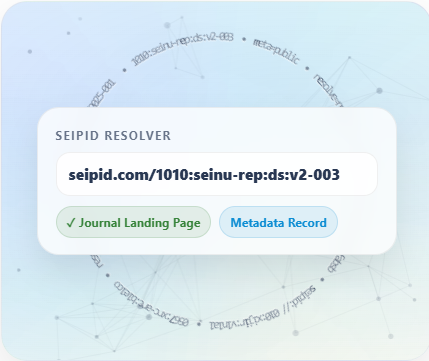
Alongside the reopening, XRC has also announced a special provision for individuals and institutions already connected to its ecosystem. Those who have previously received any certificate—whether through a course, specialization, conference, seminar, or related program—from Xpertno Research Center, Expert Novice Group, SEINU, or any constituent unit, may be eligible for added benefits, provided that their certificate is verifiable through XNVE.
According to the announcement, eligible certificate holders may receive the opportunity to extend their SEIPID trial validity and obtain additional SEIPIDs, offering them a stronger entry point into the platform’s developing infrastructure. The move appears intended not only as a practical incentive but also as a gesture of continuity toward those who have already engaged with XRC’s academic and training initiatives.
This special extension mechanism distinguishes the current reopening from a routine registration announcement. It ties SEIPID’s future-facing infrastructure to XRC’s wider educational and professional network, linking participation, verification, and access in a way that reinforces the ecosystem’s internal coherence. In effect, those who have already been part of the XRC knowledge environment are being invited to carry that engagement forward into SEIPID’s identifier framework.

Speaking on the reopening, Nasir Razzaq, CEO of Xpertno Research Center, described the step as part of a larger institutional vision rather than an isolated technical update.
“SEIPID is not merely about assigning identifiers. It is about building a more dependable scholarly environment where records remain visible, structured, and meaningful over time. Our goal is to create an ecosystem that is sustainable, accessible, and rooted in metadata integrity, so that institutions and knowledge platforms can operate with greater confidence in the digital age.”
Razzaq further emphasized that the platform is especially significant for those communities that often remain underserved by rigid or costly scholarly systems.
“Many journals, publishers, repositories, and academic initiatives have serious work, but limited access to sustainable infrastructure. Through SEIPID, we are trying to support a model where long-term discoverability and institutional reliability are not treated as privileges for only the largest players. We want to make scholarly structure more reachable without compromising seriousness.”
The reopening of registration also reflects the strategic direction XRC has increasingly taken in recent years: combining academic services, digital tools, training platforms, and governance-based systems into a more interconnected scholarly framework. Within that broader mission, SEIPID occupies a particularly important space. It is intended not merely to label outputs but to provide a structured layer through which scholarly entities and records can remain identifiable and traceable even as websites, platforms, and hosting environments change over time.
That concern is far from theoretical. Across academic and publishing spaces, unstable links, disappearing pages, and fragmented metadata remain persistent barriers to long-term discoverability. By reopening SEIPID with a clearer model and stronger onboarding incentives, XRC appears to be positioning the platform as part of a wider response to those structural problems.
The extension offer for verified certificate holders also reinforces XRC’s emphasis on verification and continuity. By requiring prior credentials to be verifiable through XNVE, the organization is effectively connecting trust in past participation with access to future infrastructure. In doing so, it strengthens the idea that scholarly ecosystems should be built not only on access but also on traceable and validated engagement.
For institutions and individuals already connected to the XRC network, the announcement may therefore carry dual significance: it opens the door to a developing identifier platform while also recognizing previous involvement in the organization's educational and scholarly initiatives. For new users, meanwhile, the reopening represents an opportunity to enter a system that is increasingly being defined by long-term digital reliability rather than short-term technical utility alone.
As SEIPID continues to evolve, this phase of reopening suggests that XRC is seeking to do more than relaunch a service. It is attempting to consolidate an ecosystem—one in which scholarly participation, metadata, verification, and institutional continuity are designed to reinforce one another.
For now, the message is clear. SEIPID registrations are officially open once again, and for many within the XRC family of platforms and programs, the reopening comes with not only access but added advantage.